What NHTSA’s Latest Robotaxi Crash Data Shows


Every article on this site is researched by our internal team, reviewed for legal accuracy against current Texas law, and held to State Bar of Texas advertising standards before publication. We do not publish content that overstates outcomes or makes promises about results.
Learn more about our
editorial standards .
Key Takeaways
- The ADS data analysis counts 1,538 distinct incidents, including 321 reported in Texas, through August 2026.
- Crash counts cannot establish safety rates because the reports contain no miles driven.
- Company-filed reports can guide an investigation but do not establish who was at fault.
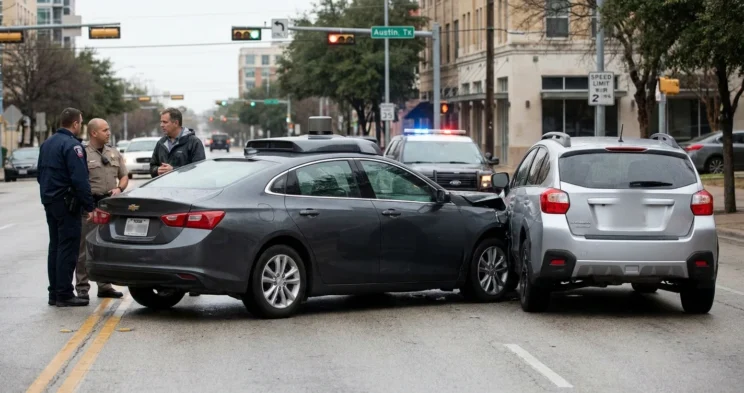
An analysis of NHTSA’s Standing General Order crash reports counts 1,538 distinct reported incidents involving automated driving systems (ADS), including 321 in Texas. The release covers reports received through September 15, 2026. These self-driving car accident statistics are crash counts, not safety rates or findings of fault.
The robotaxi crash data also includes testing vehicles, shuttles, delivery vehicles, and trucks.
What the Latest NHTSA Automated Driving System Crash Reports Count
The analysis counts 1,538 incidents through August 2026: 1,537 from June 2025 through August 2026, plus one from April 2025. September 2026 crashes are excluded.
| 2025 | Jun | Jul | Aug | Sep | Oct | Nov | Dec |
| Incidents | 59 | 66 | 61 | 67 | 97 | 112 | 109 |
| 2026 | Jan | Feb | Mar | Apr | May | Jun | Jul | Aug |
| Incidents | 118 | 92 | 145 | 141 | 118 | 129 | 120 | 103 |
Structured crash dates identify months, not exact days. The data retains each report’s latest version and removes duplicate incidents reported by two companies.
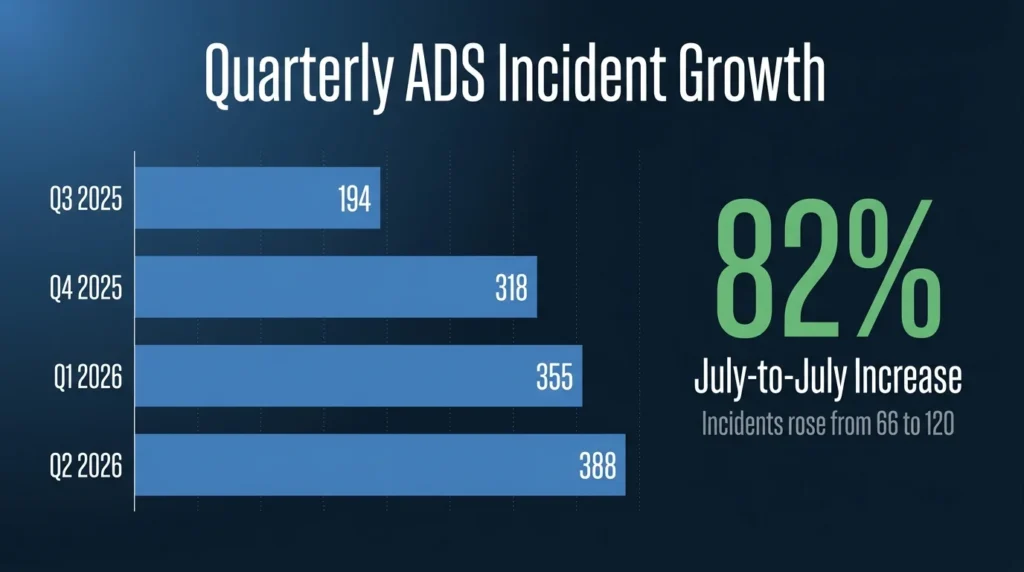
Quarterly counts were:
- 194 in Q3 2025
- 318 in Q4 2025
- 355 in Q1 2026
- 388 in Q2 2026
July-to-July counts rose from 66 to 120, an increase of about 82%.
Why a Crash Count Is Not a Safety Rate
The file has no miles-driven denominator, so these counts cannot establish whether risk rose or fell, nor can it rank companies by safety. Changing operations could affect counts, but the data does not establish the cause of the increase. June 2025 was a reporting-regime transition month, making it a poor baseline.
NHTSA’s data dictionary and release log explains the fields and distinguishes the reporting cutoff from incident dates.
Which Companies and Places Appear Most Often
Waymo is the reporting entity for 1,273 incidents (82.8%). Other reporting entities are Avride (81), Zoox (77), Tesla (36), May Mobility (20), Motional (13), Nuro (7), Aurora (8), Beep (4), and Stack AV (2).
MOIA accounts for five incidents, Gatik for three, and Waabi and PlusAI for two each. TORC, WeRide, Ohmio, Oxbotica, and Hyundai each account for one incident. The shared Hyundai/Motional incident is counted under Hyundai, although Motional operated the vehicle.
In terms of where the incident occurred, California (802), Texas (321), and Arizona (206) together account for 1,329 incidents, or about 86%. These concentrations do not establish comparative risk. Other locations are Georgia (81), Nevada (47), Florida (46), Tennessee (10), Washington, D.C. (6), Pennsylvania (7), Colorado (4), New Mexico (3), Minnesota (2), Michigan (1), and Arkansas (1). One incident has no state listed.
What the Data Says About Texas Accidents
Austin has 199 reported incidents, third among the dataset’s city labels, behind San Francisco (394) and Los Angeles (256) and ahead of Phoenix (112). Dallas has 75 incidents and Houston 23.
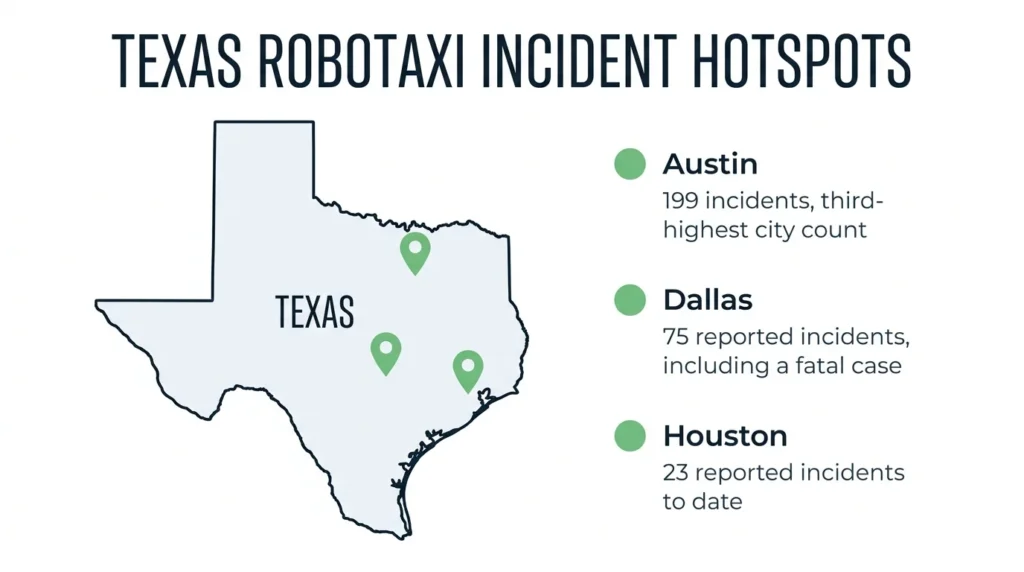
Other cities include Atlanta (79), Tempe (47), Las Vegas (41), Scottsdale (28), Miami (27), and Santa Monica (20). These are reported city labels, not metropolitan-area totals.
Eighteen reported incidents involve ADS heavy trucks: Aurora (8), Stack AV (2), Gatik (3), PlusAI (2), Waabi (2), and TORC (1). Eleven were in Texas. Reported speeds ranged from 7 to 65 mph, with a median of 34.5 mph; eight were at least 55 mph. Fifteen records report no injury, two report minor injuries, and one lists severity as unknown.
What Companies Reported About the Incidents
Companies described the ADS vehicle as stopped or parked in 775 incidents (50%) and traveling below 10 mph in 1,166 (about 76%). These figures do not establish the other vehicle’s speed, impact force, or fault.
Movement: Stopped (657); parked (118); going straight (538); turning left (68); turning right (41); changing lanes (36); passing (21); backing up (26); other (33). In 242 stopped or parked incidents, the rear contact-area field was checked. That coding does not establish a rear-end crash sequence.
Speed: 0 mph (785); 1 to 9 mph (381); 10 to 24 mph (256); 25 to 44 mph (96); 45 mph or faster (20). The maximum was 65 mph.
Crash partner: Passenger cars (483); SUVs (364); pickups (170); heavy trucks (147); buses (55); vans (49); fixed objects (93); motorcycles (15); cyclists (14); animals (13); emergency vehicles (10); scooters or skateboards (5); pedestrians (4); other (116). These selected categories are not person-level injury counts.
Road setting: Streets (1,071); intersections (303); parking lots (127); highways/freeways (31); other (6).
Reported local time: Noon to 6 p.m. (528); 6 p.m. to midnight (405); 6 a.m. to noon (375); midnight to 6 a.m. (230).
Weather: Clear (1,128); cloudy (217); partly cloudy (139); rain (61). Weather categories can overlap. Without exposure data, these autonomous vehicle accident statistics cannot establish which conditions are more dangerous.
How Many Incidents Alleged Injuries or Deaths
The data shows that 154 incidents (10.0%) alleged an injury, including two fatal incidents. Another 1,359 reported no injury, and 25 reported unknown. These numbers represent incidents, not injured people, and “no injury reported” does not prove nobody was hurt.
| Highest alleged injury | Incidents |
| Minor, no hospitalization | 97 |
| Minor, with hospital visit | 38 |
| Moderate, no hospital visit | 4 |
| Moderate, with hospital visit | 9 |
| Serious, with hospitalization | 4 |
| Fatal | 2 |
Airbags reportedly deployed in a vehicle in 82 incidents, including the ADS vehicle’s airbags in 29 incidents.
What Waymo Reported About the Fatal Incidents
According to Waymo’s report, in Tempe in September 2025, one of its vehicles slowed to turn right while yielding to a pedestrian. A motorcycle hit the vehicle’s rear-left corner, the rider fell into the road, and a passing car struck the rider and left. Waymo reported the vehicle’s speed as 8 mph and said the rider later died at a hospital.
According to Waymo’s report, in Dallas in August 2026, one of its vehicles slowed for a pedestrian walking in the opposite lanes of Maple Avenue. An oncoming SUV struck the pedestrian, who hit the ground and then the Waymo’s rear-left area. Waymo reported that the vehicle was moving at about 5 mph, and alleged a fatal injury.
These are company accounts, not findings of fault. The Dallas incident is included in the August 2026 data.
What a Report Can Show in a Texas Injury Case
NHTSA autonomous vehicle crash data can identify an incident, a company’s account, and possible evidence. It cannot decide fault or prove that account.
Who Must Report and When
The NHTSA’s Third Amended Standing General Order 2021-01, effective June 16, 2025, imposes duties on manufacturers and operators, not injured consumers, to report the incident. Qualifying incidents must occur on publicly accessible U.S. roads, with system engagement or attempted engagement from 30 seconds before the crash’s beginning through its conclusion. The robotaxi company must report incidents about which it received notice at least 10 calendar days after first being served with General Order 2021-01.
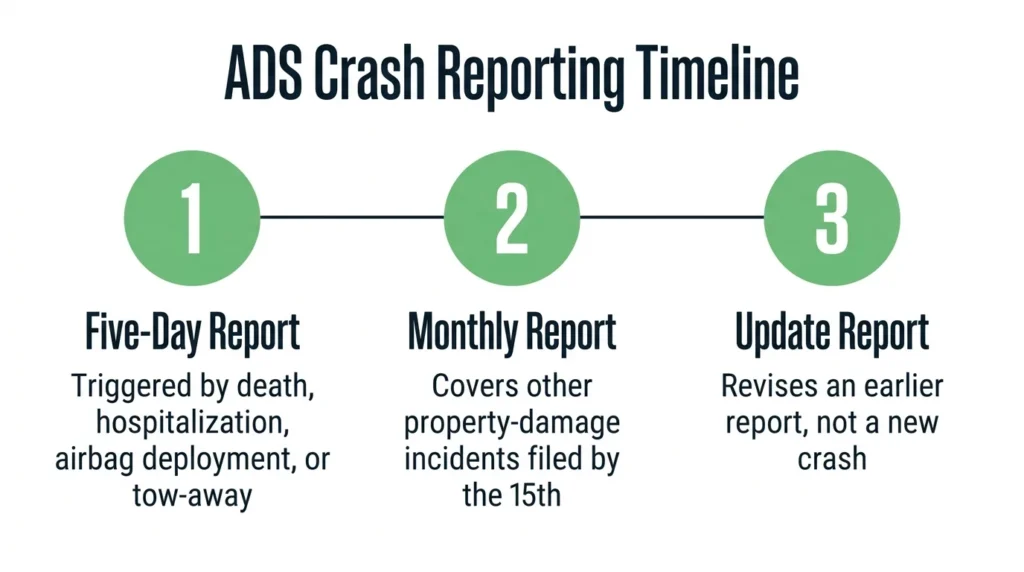
- Five calendar days after notice: Death, hospital transport for injury treatment, a vulnerable road user struck, airbag deployment, or tow-away triggers reporting. Outcomes involving other participants count; ordinary injury alone is not the hospital trigger.
- The following month’s 15th after notice: Other ADS property-damage incidents qualify when expected damage exceeds $1,000, or when damage is $1,000 or less and the subject vehicle alone was involved or struck another vehicle/object.
- The following month’s 15th: Material changes to specified fields in a prior five-day report require an update.
Weekend or holiday extensions do not apply to five-day reports. The retained versions comprise 772 Five-Day, 730 Monthly, and 36 Update reports. An update replaces an earlier version; it is not another crash or a separate severity class.
What Evidence the Reports Identify
Companies flagged video availability in 1,526 incidents, telematics in 1,480, and police reports in 33. The public file contains neither video nor telemetry, and availability flags do not establish public access, preservation, or access in a particular case.
The data also shows whether an automated driving system was engaged. It lists 1,493 verified engaged systems, 41 verified not engaged, 2 alleged engaged, and 2 unknown. This covers the reporting window, not necessarily automated control at impact.
A case investigation can compare the company narrative with your account, witnesses, police materials, medical records, and lawfully obtained vehicle data. Texas car accident lawyers can help assess that evidence and the questions a company report leaves unanswered.
Talk With Angel Reyes & Associates About a Robotaxi Crash
If you were injured in a self-driving vehicle crash in Texas, Angel Reyes & Associates can review your account and available evidence. A company-filed NHTSA report, when one exists, can provide an early starting point for that investigation and support your robotaxi accident claim. With 30 locations throughout Texas, our team is available 24/7 to discuss your case.
Contact Angel Reyes & Associates for a free consultation.
Past results do not guarantee future outcomes.
Witness Statement FAQs
Does a higher number of reported robotaxi crashes mean a company is less safe?
No. These are company-reported crash counts across different ADS operations, and the file has no miles-driven figures needed to compare crash rates or rank companies’ safety.
Why does NHTSA list both five-day and monthly ADS crash reports?
The current reporting order requires a report within five calendar days when a qualifying crash involves a death, hospital transport for injury treatment, a vulnerable road user struck, airbag deployment, or a tow-away. Other qualifying property-damage crashes follow the monthly schedule. An updated report revises an earlier filing; it is not another crash.
What does "system engaged" mean in NHTSA's crash data?
It refers to whether the automated driving system was engaged, or engagement was attempted, during the reporting window from 30 seconds before the crash began through its end. It does not necessarily mean the ADS controlled the vehicle at impact.
Can I get the video or vehicle data mentioned in an ADS crash report?
The public crash file does not contain the video or telematics data. A company’s checked availability flag does not establish that the material is public, preserved, or obtainable in a particular case.
What should someone in Texas do if a self-driving vehicle was involved in their injury crash?
Use any company-filed NHTSA crash report as an early lead, then compare its account with your recollection, witnesses, police materials, and medical records. The report alone cannot determine fault.
About the Authors

Angel Reyes
Writer
Angel L. Reyes, III is the Founder and Managing Partner of Angel Reyes & Associates. A nationally recognized trial attorney and business leader, Angel founded the firm in 1993, which has gone on to help over 70,000 injury victims recover more than $1 billion. Named to the Texas Super Lawyers list annually since 2008, Angel brings Wall Street experience, Ivy League education, and a deep commitment to client advocacy. He is a frequent legal commentator and published author with extensive contributions to legal scholarship, trial strategy, and consumer protection.

Kyle Nicolas
Editor
Kyle Nicolas is the Web Content & SEO Manager at Angel Reyes & Associates. He has more than 10 years of experience as a marketing co...

Angel Reyes
Reviewer
Angel L. Reyes, III is the Founder and Managing Partner of Angel Reyes & Associates. A nationally recognized trial attorney and business...