




What to Do If You’re in an Accident and Nobody Gets Hurt


Every article on this site is researched by our internal team, reviewed for legal accuracy against current Texas law, and held to State Bar of Texas advertising standards before publication. We do not publish content that overstates outcomes or makes promises about results.
Learn more about our
editorial standards .
Key Takeaways
- If a collision did not cause any injuries, there is generally no reason to get a lawyer involved in the case.
- Symptoms of conditions like whiplash or concussion can surface days after a crash that felt minor.
- The two-year deadline under CPRC § 16.003 runs from the crash date, not symptom onset.
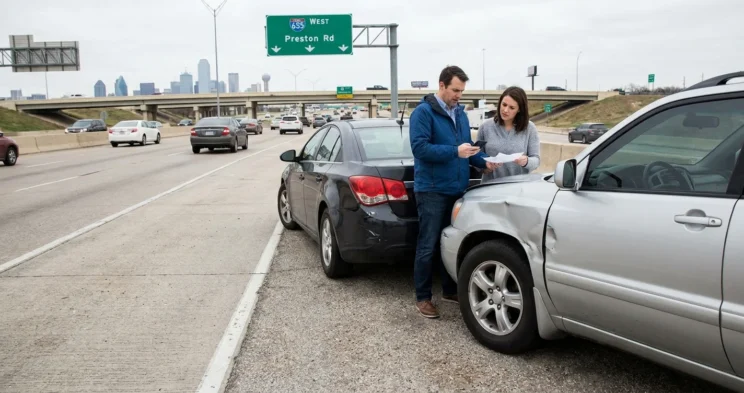
You were heading home a night out in Lower Greenville one evening when traffic stopped short and the driver behind you tapped your bumper. Everyone got out, looked at the damage, and agreed nobody was hurt. The cars are dented but drivable, and the other driver is asking if you really need to involve insurance at all.
Generally, if nobody is hurt, there’s no reason to get an attorney involved in your case. However, before you decide whether this is the case, slow down. A crash that looks minor at the scene can still create injuries that don’t show up for days or even weeks. Likewise, those involved still have legal duties and insurance steps to follow.
Delayed Injuries Injuries Don’t Show Right Away
Feeling “fine” right after a crash is not the same as being uninjured. Adrenaline and shock can mask pain for hours or days, and soft-tissue damage, concussion, and internal bleeding often go unnoticed at the scene. A same-day medical check creates a record that ties any later symptoms to the wreck and protects your health first.
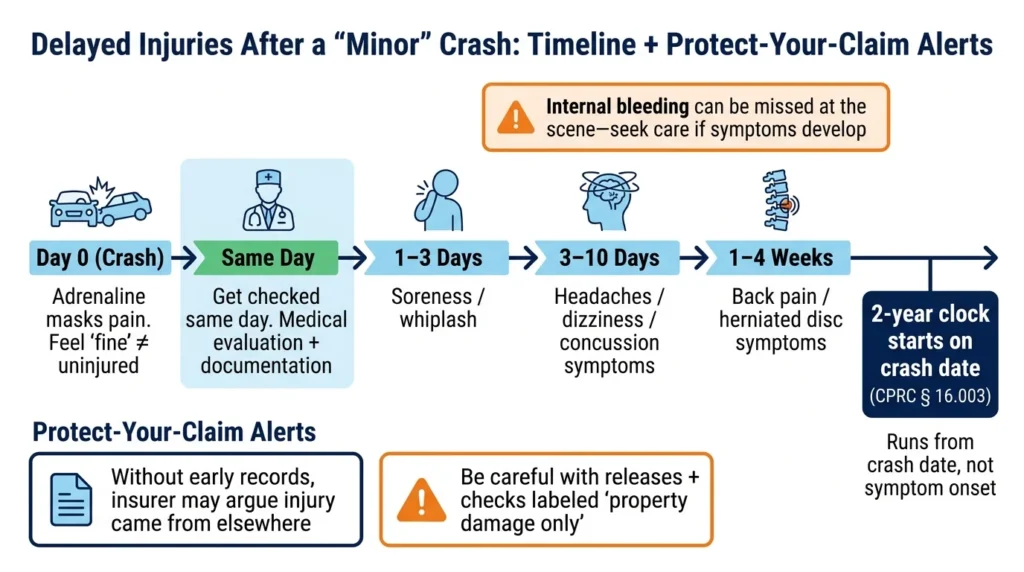
Whiplash, herniated discs, traumatic brain injuries, and internal bleeding all have delayed onset patterns. You might wake up with a stiff neck two days later. You might develop headaches, dizziness, or back pain a week out.
You felt fine a week ago, but now you’re dealing with persistent pain since your accident. Without a medical record from soon after the crash, an insurer can argue the injury came from somewhere else. That single missing document can quietly close the door on a real claim.
This is why we strongly advise getting yourself checked by a medical professional and having your condition documented if the collision occurred while traveling 20 miles per hour or more. If one or more of the vehicles involved is at risk for potentially being declared a total loss, a delayed-onset injury may also be present.
Your Legal Duties at the Scene
Texas law requires every driver in a crash to stop, exchange information, and in some cases report the wreck, even when nobody appears hurt. The duty to stop and the duty to report are separate rules. Skipping either can create criminal exposure and complicate any later insurance claim.
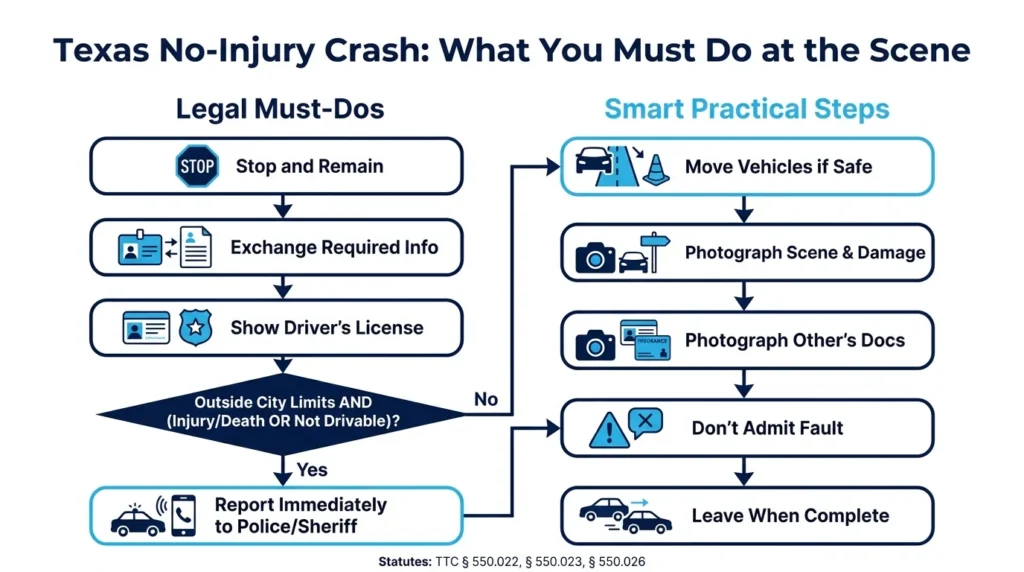
Under Texas Transportation Code § 550.022, every driver involved in a crash that damages a vehicle must stop at or near the scene and remain until all legal requirements are met. Texas Transportation Code § 550.023 then requires you to give your name, address, vehicle registration, and the name of your liability insurer to any other driver or occupant involved, and to show your driver’s license on request. Leaving without doing this is a criminal offense.
If the crash happens outside city limits and results in injury, death, or a vehicle that cannot be safely driven, Transportation Code § 550.026 requires you to report it right away to the nearest police department or sheriff’s office.
Before September 1, 2017, § 550.061 required drivers to file a written crash report (the CR-2) within ten days whenever damage appeared to be $1,000 or more and no officer investigated the crash. However, SB 312 repealed that requirement. TxDOT no longer accepts or retains these forms.
While you handle these duties, take practical steps:
- Move vehicles out of traffic if it’s safe to do so.
- Photograph all damage from several angles, plus the scene with a street sign or landmark in frame.
- Photograph the other driver’s license and insurance card.
Do not admit fault or guess at the cause. Texas uses proportionate responsibility rules, and an offhand comment at the scene can shift liability later.
Filing an Insurance Claim After a No-Injury Crash
Even in car accidents where nobody is hurt, you need to handle the insurance side carefully. Notify your own insurer promptly, gather the right documents, and decide which claim path fits your situation. The Texas Department of Insurance guidance on what to do after a wreck recommends reporting the crash to your carrier before you choose how to pursue repairs.
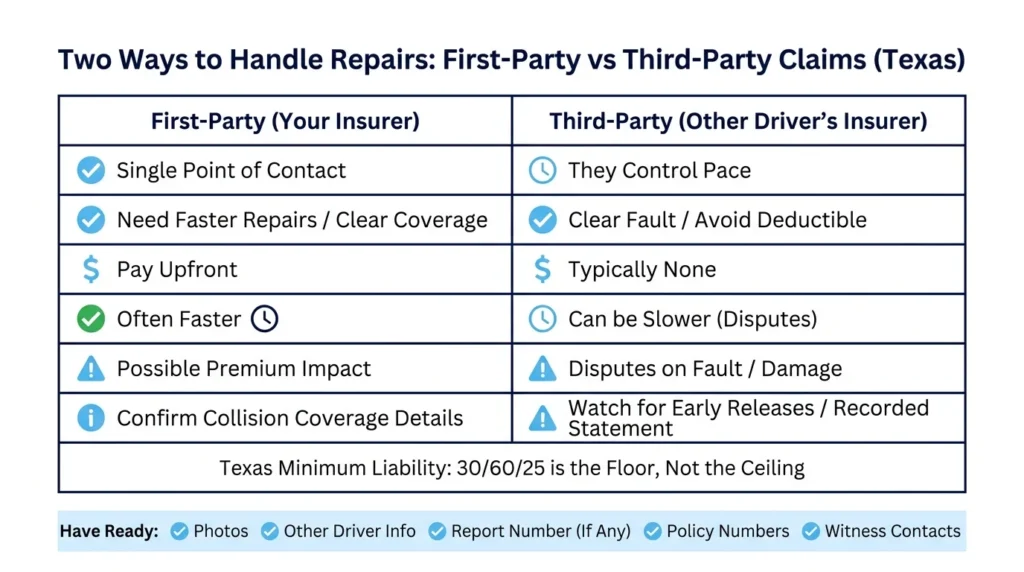
You generally have two routes: first-party claims and third-party claims.
First-Party Claims
A first-party claim goes through your own insurer using your collision coverage. It’s usually faster and gives you one point of contact. The tradeoff is your deductible upfront and possible premium effects.
Collision coverage pays for damage to your vehicle regardless of fault. Your personal liability coverage pays for any damage deemed to be your fault.
Texas minimum liability coverage under Texas Transportation Code § 601.072 sits at 30/60/25. That’s the floor, not the ceiling. If the other driver carries only the minimum, your third-party recovery may fall short, which is worth understanding through this breakdown of Texas minimum car insurance requirements.
Third-Party Claims
A third-party claim goes straight to the at-fault driver’s liability insurer. No deductible, no premium hit for you, but the other insurer controls the pace and may dispute fault or the value of your damage.
You’ll need the other driver’s insurance information and the police report number if one exists. The insurer will assign an adjuster and inspect your vehicle.
Do not give a recorded statement to the other driver’s insurer before thinking it through. Adjusters use those statements to lock in facts that can limit what you recover if injury symptoms surface later. This overview of how car accident claims work in Texas covers the adjuster process in more detail.
Documents to Gather Before You File
Before you call any insurer, pull together the paperwork that will move the claim forward. Having everything ready in one place shortens the back-and-forth and keeps an adjuster from delaying with information requests.
You’ll want:
- The police report or crash report number, or your CR-2 copy if you filed one.
- Photos of all damage, the scene, street signs, and any road hazards.
- The other driver’s full name, contact info, driver’s license number, license plate, vehicle make and model, and insurance carrier with policy number.
- Names and contact details of any witnesses.
- Your own claims contact number and policy number from your insurance card or app.
- Any medical records or receipts from a post-crash evaluation, even a quick urgent care visit.
If documentation questions pile up or the other driver’s insurer starts disputing damage, a conversation with someone who handles Texas car accident claims can help you understand your options before you commit to a path.
If You Discover You Were Actually Injured
Delayed-onset injuries are unfortunately a reality, and they’re a tough one to deal with under Texas law. Civil Practice and Remedies Code § 16.003 mandates a two-year deadline clock that starts on the crash date, not the day your symptoms appear. Waiting weeks to see a doctor can eat up part of your filing window before you even know you have a claim.
If symptoms show up, move quickly. See a doctor, save the visit notes and diagnosis, and hold onto every piece of evidence from the original crash: photos, police report, texts and emails with insurers.
Be careful what you sign. The other party’s insurer will likely be quick to toss you a “property-damage-only” release to sign before symptoms appear. This single signature can wipe out your right to bring a later injury claim. Read anything you’re asked to sign, and don’t accept a check from the other driver’s insurer without understanding what rights come with it.
Talk to an Attorney If Your Situation Changes
Most no-injury crashes resolve through insurance without a lawyer ever getting involved, and that’s fine. But if symptoms appear or an insurer starts pushing a release before you’re sure, the situation has changed and the stakes go up.
Angel Reyes & Associates has decades of experience handling Texas car accident injury claims, including crashes that looked minor at the scene but turned out to involve real harm. We work on contingency, meaning you pay no fees unless we win, and have recovered more than $1 billion for clients over the years.
We offer free consultations, and our team of attorneys can review where your case stands. If your situation has shifted, contact us today to talk it through.
Past results do not guarantee future outcomes.
Minor Car Accident FAQs
Can the other driver's insurer deny my property damage claim if I don't give a recorded statement?
Texas law does not require you to give a recorded statement to another driver’s insurer as a condition of having your vehicle repaired. However, the other insurer may delay processing your claim while it investigates, so knowing your options before that pressure builds matters.
What happens if the other driver was uninsured and my crash was property-damage-only?
If the at-fault driver has no insurance, you can file through your own uninsured motorist property damage (UMPD) coverage if your policy includes it. Texas insurers are required to offer UMPD coverage, but drivers can reject it in writing, so check your declarations page to see whether you have it.
How long does a property damage claim typically take to resolve in Texas?
Texas Insurance Code Section 542.056 requires an insurer to accept or reject a claim within 15 business days of receiving all requested items, and Section 542.058 requires payment within five business days after acceptance. Disputes over fault or repair estimates can extend that timeline.
Will a no-injury accident show up on my driving record in Texas?
A crash that is reported to law enforcement or filed as a CR-2 can appear on your Texas driving record regardless of whether anyone was injured. The Texas Department of Public Safety maintains crash records, and insurers may review your driving history when calculating your premium at renewal.
Can I recover compensation for a rental car while my vehicle is being repaired after a no-fault crash in Texas?
If the other driver was at fault, their liability insurer is generally responsible for your rental costs during a reasonable repair period. If you file through your own insurer instead, rental reimbursement coverage must be part of your policy for those costs to be covered.
About the Authors

Angel Reyes
Writer
Angel L. Reyes, III is the Founder and Managing Partner of Angel Reyes & Associates. A nationally recognized trial attorney and business leader, Angel has helped over 55,000 injury victims recover more than $1 billion since founding the firm in 1993. Named to the Texas Super Lawyers list annually since 2008, Angel brings Wall Street experience, Ivy League education, and a deep commitment to client advocacy. He is a frequent legal commentator and published author with extensive contributions to legal scholarship, trial strategy, and consumer protection.

Kyle Nicolas
Editor
Kyle Nicolas is the Web Content & SEO Manager at Angel Reyes & Associates. He has more than 10 years of experience as a marketing co...

Angel Reyes
Reviewer
Angel L. Reyes, III is the Founder and Managing Partner of Angel Reyes & Associates. A nationally recognized trial attorney and business...